What the ADLM Data Science Symposium Revealed About the Future of Laboratory AI
Lab Notes | Issue 8 | August 2, 2026
This past week I attended ADLM’s Annual Meeting in Anaheim for the Data Science Symposium, where I had the opportunity to hear from some of the leading voices in clinical laboratory data science. I also spent a couple of hours walking the expo floor talking with major laboratory vendors.
What surprised me most was that those two experiences told very different stories about the future of AI in laboratory medicine.
On the symposium stage, speakers described a future where laboratory data becomes more contextual, visual, and clinically meaningful through AI and advanced analytics. On the expo floor, many vendors were noticeably cautious, reluctant even, to discuss how AI is being incorporated into their products.
That contrast became the central theme of my day. By the end of the symposium, it was clear to me that the gap between research and commercial products represents one of the biggest opportunities facing laboratory professionals today.
Making the Invisible Visible
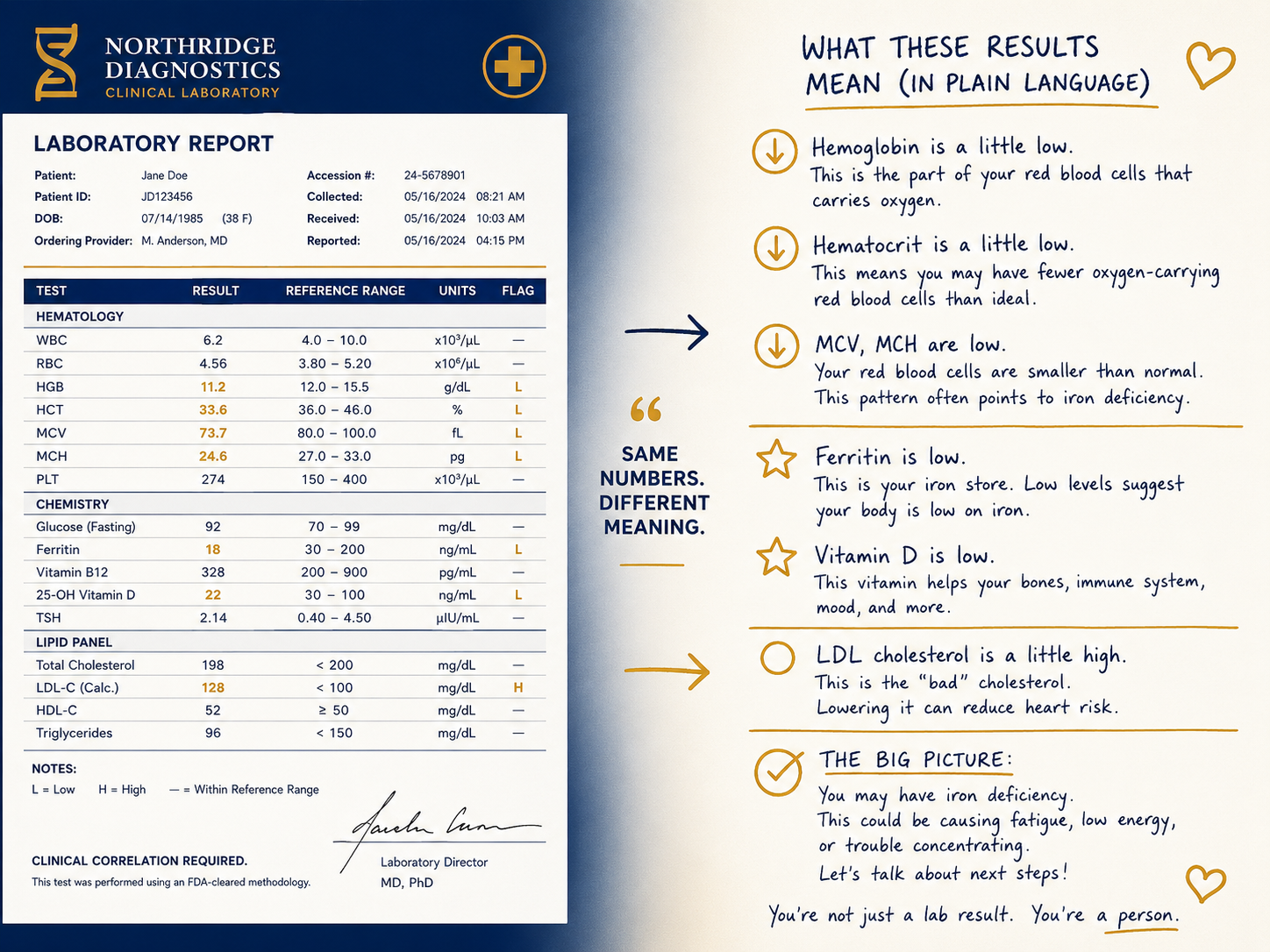
Dr. Brian Jackson, from the University of Maryland, delivered the keynote address at the 2026 ADLM Data Science Symposium, and he opened with a small, blunt provocation: a raw HL7 message on the screen. A hemoglobin of 6.9, flagged critically low, formatted exactly as your LIS has been formatting results for decades.
OBX|1|NM|718-7^Hemoglobin [Mass/volume] in Blood^LN|1|6.9|g/dL|12.0-15.5|N|||F|||20260711114100|
Nothing wrong with the message itself. Jackson’s point was that the standard data structure behind every lab result we generate, analyte name, result, units, reference interval, a high or low flag, maybe a free-text comment, is a container built for a number. It was never built for meaning. He traced that flag system straight back to the 1970s and 80s, when lab results were printed on paper and a flag was the only practical way to say “look at this.” We are still using a paper-era signal on a screen that could show far more.
Then he showed what “far more” looks like. Instead of reporting a single flagged value, plot it. He put up a longitudinal graph of red cell parameters, several of them together, each trending downward over months with the reference range shaded in behind them. One flagged low hemoglobin tells you almost nothing. A trend line showing every red cell parameter drifting toward the floor of normal over six months tells you a story worth investigating.
He returned to that idea with a live clinical case: a 27-year-old Black patient with psoriasis and the Duffy Null genetic variant, on immunosuppressive therapy, with persistently low neutrophil counts. Flagged in isolation, that result reads as an emergency, a reason to pull a patient off medication they need. Plotted as a longitudinal chart instead, it reads as exactly what it is: benign ethnic neutropenia, stable near the bottom of the reference range for months, well documented, not a crisis. Same data. Completely different clinical decision, depending on whether you see a flag or a trend.
The most fully realized example he showed came out of the University of Utah: a graphical display for neonatal bilirubin, now live inside their Epic system. Bilirubin risk in a newborn changes by the hour during the first days of life, so a single reference range cannot do the job. The Utah team built a display with curved reference lines, green for expected, red for the risk zone, that shift hour by hour, plotted against the baby’s actual measured values, with phototherapy and exchange transfusion periods marked directly on the same chart. One team spent roughly a year building it. Jackson’s estimate: another hospital could implement the same display in a month or two, once it exists as a template to build from.
That last point was also his pivot to the hard problem. You cannot hand-build a custom graphical display for every clinical scenario in medicine, there are hundreds of thousands of them. His proposed answer was AI that infers clinical context directly from the EHR, diagnosis, current and planned therapy, patient-specific factors, paired with a curated catalogue of graphical displays and a user interface that lets a clinician move between the right views quickly. Not a replacement for clinical judgment. A replacement for handing someone a number and calling it done.
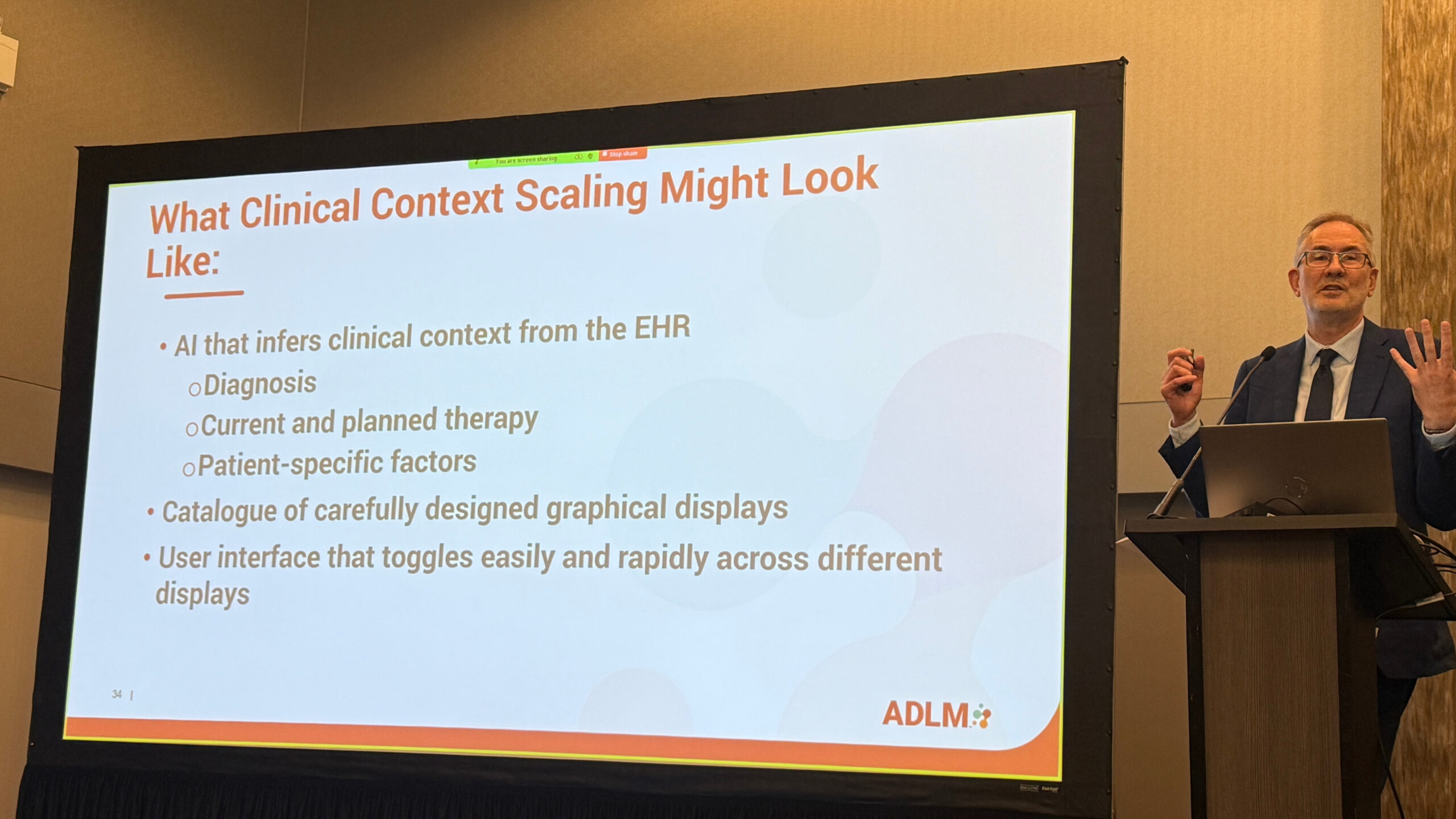
I agree with him on the visual display, and it stuck with me for a personal reason. As a patient, I can log into my own MyChart and see my lab trends laid out over time. But when I think about what a clinician actually sees on their side of the same chart in Epic, I am not sure that graph exists for them. From what I have observed in Beaker, the view tends to be tabular: a column of numbers across dates, not a plotted trend. If that is the default experience for clinicians, a graphical display would be a meaningful upgrade on its own, before AI ever enters the picture.
Where I think AI actually earns its place is one layer beneath that: pulling in the context a clinician would otherwise have to go hunt for. Flagging that a patient is on immunosuppressive therapy. Surfacing a relevant blood phenotype or known genetic variant like the one in Jackson’s example. Not deciding what the lab value means, but assembling the information a clinician needs to make that judgment at a glance, instead of piecing it together from four different places in the chart. The clinician still decides whether a value is clinically significant, or whether a patient is hemodynamically stable, in light of everything else going on. AI’s job is to make sure they are deciding with the full picture in front of them, not a flag and a number.
What the Expo Floor Said
Before the symposium, I walked the expo floor with my DJI Osmo Pocket 3 in hand, ready to record, with a simple question: how are the major lab vendors integrating AI and machine learning into their platforms?
The answer, more or less, was: we will have someone from our marketing team follow up with you.
One large vendor told me they are very conservative in how they discuss AI and redirected me to their communications director for what she described as their official position. She did mention, almost in passing, that their organization uses Copilot internally. That was not exactly what I was asking.
The pattern across the floor was consistent. During one “off-the-record” conversation, an industry representative suggested that vendors are moving cautiously largely because AI introduces complicated questions of liability and regulatory oversight. If an algorithm contributes to a clinical error, responsibility quickly becomes difficult to define. Their caution is understandable, but it also creates an opportunity for laboratories and health systems to innovate faster than commercial platforms.
What that dynamic points toward is an opening for labs, academic medical centers, and health systems to build that sense-making layer themselves. To be clear about the architecture here: in an Epic environment, Beaker, the laboratory information system, and the electronic health record are not two separate systems fighting to talk to each other. They are connected modules from the same vendor, and the lab results generated on the Beaker side already flow out to the chart that bedside clinicians and nurses see. The gap is not connectivity. The gap is synthesis: something that takes the diagnosis codes, the symptoms a patient is reporting, and the lab results already sitting in that connected record, and turns them into a contextualized, visual display instead of a table of numbers. The vendors supply the infrastructure that moves the data. The institutions are going to have to build the layer that makes sense of it.
Jackson made almost this exact point in his closing remarks, before he opened the floor to questions. He said he believes the laboratory is positioned to lead this work, that this kind of sense making, this computer-to-human translation, has been underappreciated, underexploited, and underoptimized across the field, and that the people equipped to fix it were sitting in that room. I agree with him, and I think it is a genuine opportunity for lab professionals to innovate in a space vendors have been too slow, or too cautious, to build.
What the Lightning Talks Showed
If the keynote described what a data-rich, context-aware lab could look like, what followed, both on the lightning talk stage and a few steps away in the poster session, showed three labs actually building pieces of it, right now, with tools they already had.
Dr. Bernard Cook, from Henry Ford Health, walked through what his team’s daily quality huddle used to look like: hand-filled bubble charts, paper Pareto diagrams, a spreadsheet buried in someone’s inbox. He put the old system on screen next to the new one, a Power BI dashboard that pulls LIS data every morning at 6 a.m., pulls defect data from Smartsheet, and embeds shift report narratives and countermeasures into a single view. Nobody has to be in the room anymore. Leaders off-site can join the huddle from a browser. It monitors turnaround time and defects for five critical assays and gives the team three months of trend data on demand instead of a filing cabinet of hand-drawn charts.
Dr. Kyana Garza, from UC Irvine, took the lightning talk stage to present closed-loop electronic critical value notification: a tiered system her team built to replace the traditional phone call, the one where a tech has to reach a provider, read back patient identifiers, and document the whole exchange by hand. A verified critical result triggers an automated push alert. If nobody acknowledges it within a set window, the system escalates to a secure chat message, and only as a last resort, to a phone call.
At another poster session stop, I reviewed the work David Ramos and team at Tampa General had built. They too had built a closed-loop electronic communication workflow for CAV’s for inpatients.
The results were not subtle. At UC Irvine, phone calls for chemistry critical results dropped from 38.7 percent of all notifications to 9.77 percent after adding the secure chat step, a 91 percent reduction, saving an estimated 692 tech hours and 57,000 to 83,000 dollars a year. At Tampa General, 71 percent of inpatient critical values closed electronically with a median acknowledgment time of 47 seconds, eliminating over 19,000 phone calls and saving more than 950 medical laboratory scientist hours over six months, with no increase in missed notifications.
None of this required a vendor to ship a new AI product. It required labs willing to use the reporting tools already sitting inside their LIS, and staff willing to spend the time building and tuning something nobody outside the lab was going to build for them. It is the same argument the expo floor made by staying quiet, just with numbers attached.
The Panel: Where Regulation Meets a Model That Keeps Learning
The afternoon panel, moderated by Dr. Mark Zaydman from Washington University and made up of Nick Trentadue from Epic, Dr. Michael King (presenting in personal capacity and not on behalf of Roche) and Dr. Sarina Yang from Weill Cornell, took on a hot topic: how do you regulate a laboratory AI tool that keeps changing after it has already been deployed?
Laboratory medicine, someone on the panel pointed out, is one of the more rigorous, evidence-driven corners of healthcare precisely because a test gives you an answer that has been validated. That is also what makes continuously learning AI models so challenging to work with. Traditional regulatory frameworks were built around locked software, something you validate once and leave alone. A model that continuously learns and is updated does not fit that picture of oversight. Nobody on the panel had a settled answer for how often it needs to be revalidated, who signs off on a meaningful change, or what counts as a meaningful change in the first place.
What struck me most was an aside from the moderator: this exact question, whether continuous learning systems need a new validation framework, was raised at last year’s symposium too, and a year later the panel acknowledged there has not been much movement. The Epic representative offered an analogy I keep ruminating over: adaptive cruise control does not require you to switch it off the moment traffic gets complicated; you take the wheel when you need to and hand it back when you do not. His argument was that the goal is not a single on-off switch for AI oversight, it is building the comfort and the infrastructure for people to take over smoothly when a model needs a human, and to know when that moment is.
That is a reasonable framing. It is also, notably, not a regulatory answer. It is an engineering and culture answer standing in for the regulatory one that has not arrived yet.
The Data Blocking Problem Not Mentioned From the Stage
After the keynote, I had a brief conversation with Dr. Jackson, and it surfaced something that deserves more attention.
When Jackson talks about de-monopolizing lab data, he is describing a technical goal. In practice, there is a structural barrier in the way: data blocking.
The short version: major EHR vendors have FHIR APIs that theoretically enable data exchange. In practice, those APIs are largely available to third-party app developers (vendors building applications on top of Epic’s platform, for example) but not easily accessible to the healthcare organizations that are Epic’s actual customers. A health system cannot readily use the same FHIR interface to extract its own patient data and pipe it into an external model. Third parties can. Customers, in many cases, cannot.
This is the friction underneath Jackson’s vision. Building the computer-to-human layer he described, AI that infers clinical context from the EHR, requires access to the EHR data. And that access is controlled by the EHR vendor, not the lab, not the health system, not the academic researchers who want to build the model. The 21st Century Cures Act created provisions against data blocking, and the ONC has been working on enforcement. But the practical reality in 2026 is that the data exists, the technical standards exist, and the access is still remarkably difficult to get in many institutional settings.
This is worth following. I am going to read more about it.
One More Thing: CAP and the AI Checklist
I also stopped by the CAP booth, and I asked whether AI and machine learning are going to appear in the CAP accreditation checklist. The answer was informative.
There is no fall 2026 checklist update. CAP is in the middle of its reapplication process with CMS, and checklist changes are on hold. The next update is expected toward the end of 2027. CAP does have an AI committee, and the possibility of AI-related requirements appearing in the next checklist is real, but nothing is finalized, and nothing has been integrated yet.
For laboratory directors and quality managers: if you have been waiting for regulatory guidance before building your AI governance framework, the 2027 timeline gives you some runway. I don’t recommend mistaking that runway for permission to wait. AI changes rapidly, as you may already be aware. Get into the game now to understand the playing field. Then adapt as it changes.
A Few Other Things Worth Mentioning
Two poster session projects are worth a quick mention, if only because they show how wide the range of data science is at a symposium like this.
Kathleen Madden and colleagues at the University of Minnesota built a predictive model for one-year post-transplant kidney function using pre-transplant donor characteristics: donated kidney volume, donor age, and donor GFR. There is nothing about it that would get labeled AI on a vendor’s marketing slide. It is careful, traditional biostatistics, the kind of work that quietly makes transplant counseling better without ever using the word intelligence. It is also a good reminder that not everything useful at this symposium needs a large language model attached to it.
On the opposite end, Gustavo Barra and his team at Sabin Diagnóstico in Brazil applied lexicon-based sentiment analysis to customer service messages on WhatsApp, scoring tens of thousands of comments as positive, neutral, or negative without training a custom model at all. After combining that with workforce and technology changes, their customer satisfaction score climbed from 78 percent to 87 percent over three months. It is a small reminder that the same tools showing up in critical value notification and diagnostic pipelines are also showing up in the parts of a lab’s operation that have nothing to do with a test result, and that this work is happening well outside the United States too.
And one more thing, during the closing remarks, Dr. Sarah Wheeler launched the 2026 Data Storytelling Challenge, open to members and nonmembers, with trainees especially encouraged to submit. Submissions open August 1st, close November 1st, finalists are announced in December, and winners in February 2027. If you have been sitting on a good data story from your own lab, this is your moment to share it. Learn more at: https://github.com/myADLM/ADLM-Data-Storytelling-Data-Challenge
The Through-Line
What struck me most about my Thursday at ADLM is how clearly the keynote and the expo floor were describing the same problem from opposite sides.
Jackson laid out the vision: a clinical laboratory ecosystem where data moves freely between systems, where AI adds context rather than just a flag, and where a lab result means something to the clinician reading it, not just to the LIS that generated it. The research exists. The technical building blocks exist. Increasingly, real-world examples exist.
The expo floor showed why the vision is still a vision. Large vendors are liability-averse. EHR data is technically interoperable, but practically locked. Regulatory frameworks are a year or more behind the technology. The institutions best positioned to build the middle layer often do not have the infrastructure or the mandate to do it.
I left Anaheim more convinced than when I arrived that the interesting work in clinical laboratory informatics over the next several years is going to happen at the institutional level, in labs and academic medical centers willing to build what the vendors are not yet willing to sell. Dr. Jackson implied it from the stage. The expo floor confirmed it by not saying anything at all.
Where My Own Research Fits
Let me be honest about why I spent my own dime to attend ADLM specifically for the Data Science Symposium. This was my 1st time attending the conference, and I actually missed most of the formal conference schedule of events. Those ended Wednesday, the same day I arrived. A colleague shared the symposium with me, and I instantly knew I needed to be there. I needed to meet the people, hear their ideas, and see the work being done in this specific space.
The panel spoke in the language of governance: validation frameworks, model drift, who signs off on a meaningful change. The lightning talks spoke in a completely different language: tech hours saved, phone calls eliminated, dollars recovered, using Claude to build Micro workflows. It was fascinating!
That is the space I keep finding myself drawn to. I am a healthcare quality professional and a doctoral student studying applied AI in clinical lab settings, which puts me in an odd, useful position: close enough to the frontline to know what Bernard Cook’s team actually needed when they got tired of hand-drawn Pareto charts, and close enough to the research literature to see where the field’s governance thinking has not caught up to what labs like his are already doing without “permission.” I think there is real value in someone spending time in rooms like this to glean from what is working, but also to identify gaps that need exploration and solutions.
If I am honest, part of why I wanted to be in that room was selfish. I wanted to hear how other organizations are actually applying AI in this field: whether they are working with large language models, fine-tuned models, natural language processing and text classification, or building out full AI workflows and pipelines, and what they are using any of it to do. I got more of an answer than I expected. Lucas Osborn, a self-proclaimed non-coder at USC, used Claude to build DAEDALUS, a bioinformatics pipeline for infectious disease next-generation sequencing. Gustavo Barra’s team at Sabin Diagnóstico ran sentiment analysis on customer service conversations. Kathleen Madden at Minnesota mined post-transplant data to find that donated kidney volume is one of the strongest predictors of graft function; the larger the donated kidney, the better the eGFR outcome tends to be. None of it looked alike. But all of it pointed at the same underlying idea: the lab sits on more patient information than almost any other part of the health system, and the data science being built around it is slowly finding new uses for that information, for population health, for personalized medicine, and even for something as unglamorous as customer service, the way Barra’s sentiment analysis project did.
The one thing I did not hear much of, outside of Barra’s sentiment analysis work, was natural language processing applied to text classification, which happens to be my own research focus. I do not think that stays a gap for long. I think NLP is coming to this field the way closed loop notification and predictive modeling already have, and I would like to be part of bringing it. I am hoping to defend my dissertation before ADLM comes back around next year, and if the timing works, I intend to submit my own findings for a presentation slot. I would like to be in that room again, this time on the other side of the podium.
The Real Opportunity
I left Anaheim genuinely excited about what comes next.
Throughout the symposium I kept coming back to the same realization: the bottleneck has shifted. The technology is advancing rapidly, and laboratories are already demonstrating what’s possible. The harder problems now are organizational rather than technical. The focus needs to be on governance, interoperability, workflow integration, and rethinking how laboratory information is presented and interpreted in clinical care.
That shift also changes how laboratories should think about AI adoption. Waiting for the “perfect” commercial solution may no longer be the best strategy. Some of the most compelling work I saw at the symposium wasn’t built by vendors at all. It was developed by laboratory professionals using the tools they already had available to solve operational problems in their own institutions.
Across the keynote, lightning talks, and poster sessions, four practical themes emerged repeatedly:
- Start by improving how laboratory data is presented. Better visualization and clinical context often provide immediate value, even before introducing AI.
- Build internal data science and informatics capability. The most impressive projects I saw were created by laboratory teams using existing reporting tools, analytics platforms, and clinical expertise rather than waiting for a vendor release.
- Treat AI as a quality improvement initiative, not simply a technology project. The strongest examples focused on reducing manual work, improving communication, shortening turnaround times, and helping clinicians make better-informed decisions.
- Develop AI governance now. Regulatory guidance will continue to evolve, but laboratories that begin building governance, validation, and multidisciplinary collaboration today will be better prepared as the technology matures.
Taken together, these projects point toward a broader evolution in the role of the clinical laboratory. For decades, laboratories have excelled at producing accurate, reliable results. The next opportunity is helping those results become easier to interpret, easier to act upon, and more meaningful within the broader clinical context.
The future of laboratory data science and AI will not be defined solely by whichever vendor releases the next product feature. It will be shaped by laboratories willing to transform data into insight long before the software industry decides to package it.
If Dr. Jackson is right, and I believe he is, the laboratory has an opportunity to become not just the producer of diagnostic data, but one of healthcare’s most important translators of clinical meaning.
That is a future worth building.
Meredith Hurston is a healthcare quality professional, doctoral student in AI and machine learning, and the editor of Lab Notes.