
AI Blood Test Tools Are Charging Hundreds of Dollars. I Built This in 2023.
Lab Notes | Issue #8
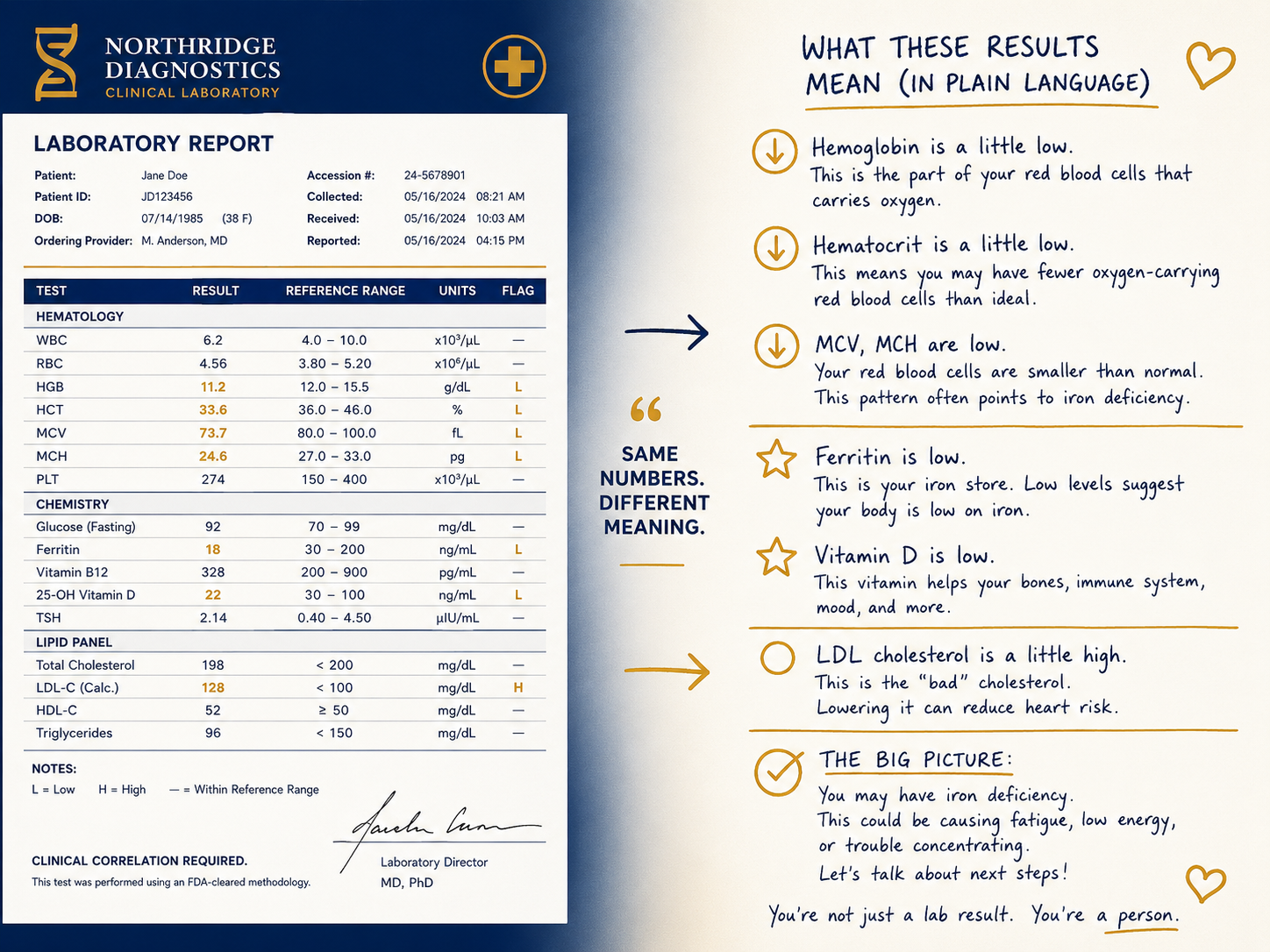
You get your lab results through MyChart before your doctor has had a chance to review them. Your glucose is 220. Your A1C came back flagged. There’s a number next to “ALT” and you’re not sure if it’s alarming or routine. It’s 8pm and your Dr.’s office is closed. So you Google it, which gives you a terrifying spiral of worst-case diagnoses, or you paste a screenshot into ChatGPT and hope for an answer you can understand.
A recent Mashable article titled “What AI Can Tell You About Your Blood Test” captures exactly this moment, and the industry growing around it. Companies like Whoop, Levels, and a startup called BloodGPT are now offering subscription-based AI services to help patients interpret their blood work. Prices range from about $10 a month to $1,499 a year. The pitch is concierge-level attention to your lab results, translated into plain language with personalized next steps.
Here’s the thing. I built a version of this in late 2023 as a GPT in ChatGPT and I called it “Lab Test Insights“. And I want to talk about what these paid services are getting right, what they’re missing, and who I think is genuinely positioned to serve patients well in this space.
The Information Gap Has Always Been the Real Problem
Long before AI, patients were getting lab results they could not interpret. Reference ranges printed on a piece of paper do not explain what a borderline result means in the context of your age, your medications, your history. Physicians often do not follow up unless a result is flagged as critical. And when results come through a patient portal before a provider review, patients are left to make sense of numbers without any clinical scaffolding.
This is not a failure of technology. It is a failure of communication infrastructure. The lab produces accurate, high-quality data. The challenge is the translation layer between that data and a patient who can actually use it.
AI does not solve the underlying problem of physician time and communication. What it does is lower the barrier to accessing a reasonable first explanation. For a patient who has never heard of creatinine or knows why it matters, having a tool explain the basics, in plain language, and point them toward a question to ask their provider, is genuinely valuable. The Mashable article quotes Dr. John Whyte, CEO of the American Medical Association, who acknowledged that physicians are not always the best communicators and do not always have enough time. That is an honest and important admission.
What I Built: Lab Test Insights
In late 2023, I created a custom GPT on ChatGPT called Lab Test Insights. It was a free tool, publicly accessible, built around a straightforward goal: help patients understand what their lab results mean without replacing their doctor.
The tool had a few preset prompts to get people started, but it also accepted any free-form question. A patient could type “my glucose was 220, what does that mean?” and Lab Test Insights would walk through what glucose measures, what the standard reference ranges are, what a result in that range generally indicates, and then, every time, it would close with a specific, well-formed question the patient could take back to their provider.
That last part was intentional and non-negotiable. The goal was not to give a diagnosis. The goal was to help a patient walk into their appointment, or send a MyChart message, with a targeted follow-up question rather than vague anxiety. There is a meaningful difference between a patient who says “my labs came back weird” and one who says “my glucose was 220 and I wanted to ask whether you think we should retest fasting or look at my A1C trend.”
Lab Test Insights was not providing medical advice in the treatment sense. It was providing the kind of health literacy support that helps patients become active participants in their own care.
What the Mashable Article Reveals
The Mashable piece does something important: it exposes the validation gap at the center of this entire industry. The AI models being used by Whoop, Levels, and BloodGPT are not specifically benchmarked or validated for interpreting lab results. Google and OpenAI both acknowledged to Mashable that their models are not cleared for this purpose. BloodGPT’s own founder admitted there are no widely accepted benchmarks for interpreting blood tests at scale at this time.
During BloodGPT’s early testing in 2024, uploading full lab reports to general-purpose chatbots like ChatGPT and Claude consistently produced errors: missed biomarkers, confused values, hallucinated recommendations. BloodGPT built a structured pipeline to address those problems, with clinician input on specific biomarkers and multiple validation checks. That is a more rigorous approach, and it matters. But they have not yet published peer-reviewed research on their accuracy.
Dr. Girish Nadkarni from Mt. Sinai put it plainly in the article: “I don’t know what the accuracy of this model is, how does it work, and where does it fail?” He argues these companies need to compare their AI outputs retrospectively against de-identified patient data and run prospective studies before making strong clinical claims.
I agree with his concern. The information gap is real and worth addressing. But charging patients $500 to $1,500 per year for an unvalidated AI service, without disclosing what the tool’s error rate looks like or where it struggles, is a different proposition than offering a free literacy tool with clear guardrails.
The Business Model Question (and Why Credentials Matter)
I want to be clear: I am not opposed to people building a business around this. Healthcare has always had a market for second opinions, for concierge services, for tools that translate complex clinical information into something a patient can act on. The business model makes sense. What matters is who is doing it and what credentials they bring to it.
There is a difference between a wellness app trained on general medical articles and a service designed and overseen by someone with deep laboratory science expertise. A clinical laboratory scientist, a clinical consultant, a pathologist, a PhD in laboratory medicine, these are the people who understand not just what a reference range says but why it was established, what analyte variation looks like, what pre-analytical factors affect a result, and where a general AI interpretation is likely to be incomplete or misleading.
The Mashable article notes that some companies use clinician review for every report a patient receives, which is an important guardrail. But it also notes that automation bias is a real risk: physicians reviewing AI outputs may rubber-stamp conclusions rather than independently evaluating them.
What I think the market genuinely needs is a new kind of professional service. Not a pure AI product, but a credentialed human using AI as a support tool, the way a skilled professional uses any analytical tool, to deliver a higher-quality, more efficient service than they could offer without it.
The DLS Opportunity
As the Doctor of Laboratory Science (DLS) degree continues to grow in the United States, I think this is one of the most natural practice opportunities for those graduates.
The DLS is a doctoral-level credential in laboratory science. Think of it the way you think of a PharmD or a clinical pharmacist: a clinician with deep domain expertise who advises, consults, and interprets, but is not an authorized prescriber. A DLS practitioner attends clinical rounds, advises physicians on test utilization, interprets lab results, and meets the credentials to serve as a laboratory director. What they do not do is write prescriptions or, to my knowledge, independently write lab orders. The expertise is advisory and scientific rather than prescriptive.
For a patient-facing lab result advisory service, that distinction does not actually matter. The service is not about treatment. It is about helping a patient understand what their results mean in scientifically accurate, contextually appropriate terms, and helping them formulate the right questions to bring to their physician. That is squarely within what a DLS is trained and credentialed to do, and at a level of laboratory science depth that a general-purpose physician or a wellness app simply cannot match.
Given the growth of direct-to-consumer lab testing, the surge in wearable health monitoring, and the increasing volume of results being delivered directly to patients without clinical interpretation, the demand for this kind of service is only going to grow.
If you are a DLS student or a recent graduate wondering where your degree fits in the current landscape, this is worth your attention.
What Good Actually Looks Like
The Mashable article quotes Dr. Whyte recommending that patients use AI to help them plainly understand their results, rather than relying on it to generate personalized health insights. I think that is the right framing, and it is exactly what I was trying to build in 2023.
The goal was never to replace a provider. The goal was to close the gap between a patient staring at a confusing number and that same patient walking into their appointment prepared to have a real conversation about it. An informed patient advocates for themselves better. An informed patient asks more targeted questions. An informed patient is less likely to dismiss a concerning result because they did not understand it, and less likely to spiral into unnecessary anxiety because they over-interpreted a benign one.
The companies charging $500 a year for AI blood test interpretation are not wrong to see this as a need worth solving. But the solution needs to be built on validated science, delivered by credentialed professionals, and designed to increase patient literacy rather than create dependency on a subscription.
I built Lab Test Insights in 2023 because I could see the gap and I had the background to do something about it. Two years later, the market has caught up to the idea. Now we need to hold it to a higher standard.
What are you seeing in your practice or your work? Are patients bringing AI-generated summaries of their lab results into appointments? I would love to hear what is happening on the ground. Let me know down in the comments.
Meredith
About the Author
Meredith Hurston is a healthcare quality professional, doctoral student, and Medical Laboratory Scientist. She writes Lab Notes, a weekly newsletter covering AI in clinical labs and healthcare. She has over 20 years of experience in laboratory medicine and healthcare operations.